
With NFL preseason over, the anticipation for the season is ramping up. Significant NFL health and safety news dropped in the past few days including another NFL CTE study, a new behavioral health network, and new disciplines for on-field safety violations.
But first, some field surface news for the Detroit Lions Week 2 game vs the Bills.
Buffalo Bills Stadium Resodding

Just 2.5 weeks before the Bills home opener vs the Lions, the natural grass field of the Bills stadium is getting a resodding. What does this mean for the Lions game? I’m not the one to ask as I barely know the difference between agronomy and astronomy.
Here is what I’m gathering - apparently, NFL grass fields get resodded regularly throughout the season, so this isn’t necessarily a big deal, or even a deal at all. But since it’s the first year of the stadium, there are likely kinks that need to be worked out.
Below is a video of the grass problem that may have prompted the resod. Video via @TheJoeMarino on X. Keep an eye on the divot that #33 leaves in the bottom left…
This is an example of the fact that natural grass isn’t a panacea for all of field turf’s woes. Grass requires more maintenance, upkeep, and replacements than turf. Also, unexpected weather conditions can wreak havoc. All that costs a lot of money. Turf has the additional advantage of easier ability to host non-football, revenue-generating events.
Players want natural grass, but are they willing to help pay for it and also offset the lost revenue of other events? It’s easy to want something if you don’t have to pay for it. (Just ask my kids.)
If the players want grass fields, it needs to be collectively bargained between the NFL and NFLPA. The NFL should welcome this bargaining to see if the NFLPA is willing to put their money where their mouth is.
In the meantime, hopefully the Bills ground crew can establish a safe playing surface by September 17, Thursday night.
New NFL Disciplines for Safety Violations
Here is the NFL press release:
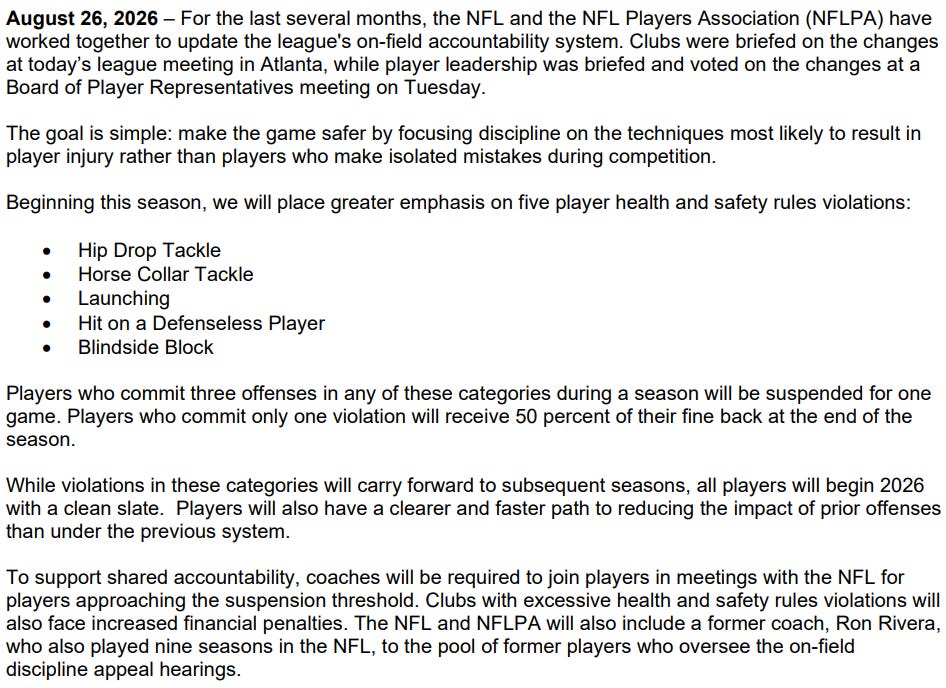
The NFL is adopting a 3-strikes-and-you’re-out (for 1 game) penalty. This adds clarity and equality to the discipline, and should help make the game safer.
As with many things in life, there can be unintended consequences though.
The negative with this hard-and-fast penalty rule is the potential loss of a star player for the playoffs or even the Super Bowl. Imagine if the Lions lost Aidan Hutchinson or Jack Campbell for a critical playoff game. This would create a firestorm of controversy and fan anger that the NFL should try to avoid.
Players who are playing beyond 17 games should probably be granted some allowance to prevent such a scenario.
The BMJ Publishes NFL CTE Study
The BMJ (formerly the British Medical Journal) recently published a study of NFL players who were diagnosed with CTE postmortem - which is the only way to diagnose CTE.
Here is the link to the full study. Below is the graphic taken from the study:
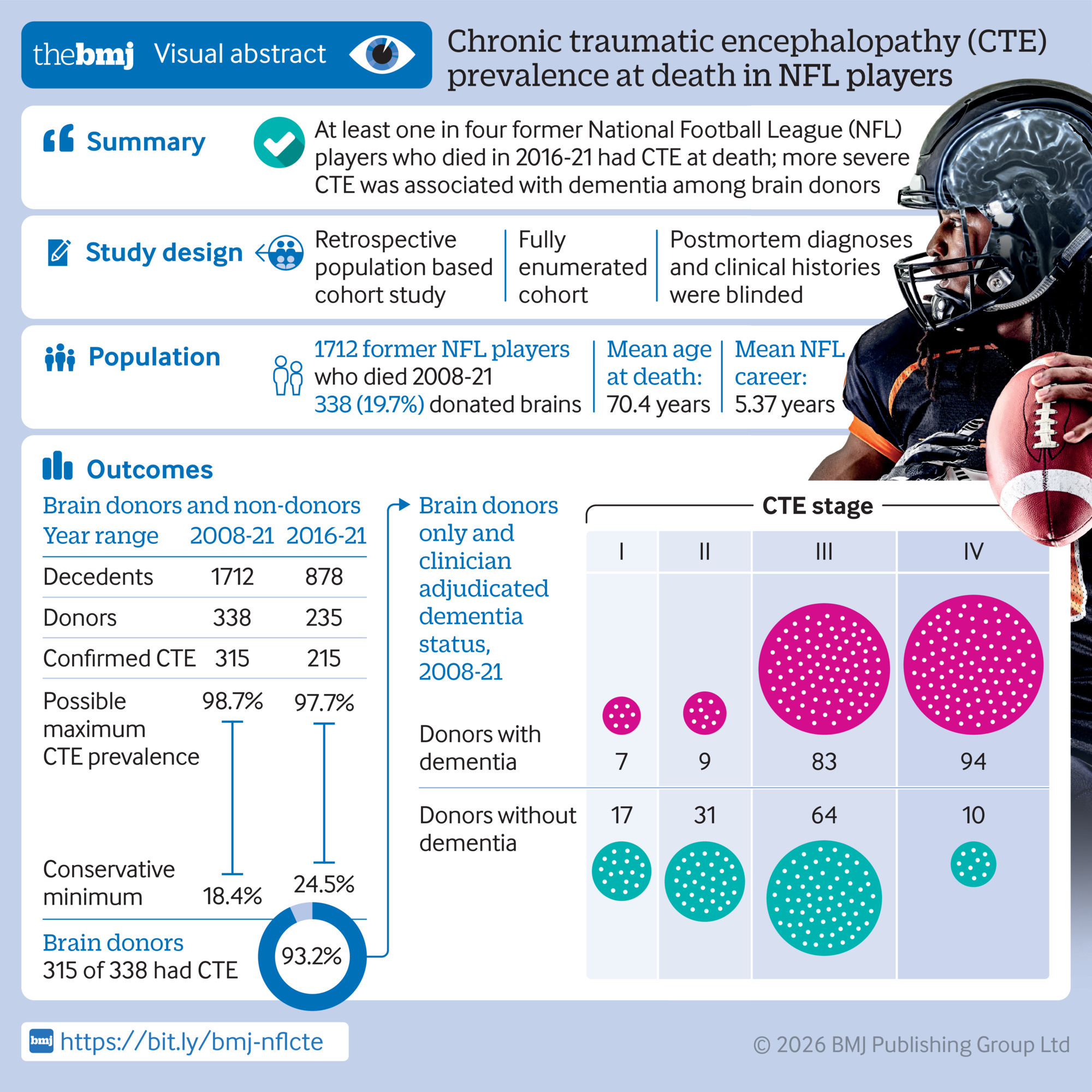
Here are my takeaways of the study:
First and foremost, it’s important to understand that there is much that is still unknown about CTE and even the brain in general. The brain is one of the least, if not the very least, understood organ systems in the body. Thus, there should be caution in coming to any definitive conclusions.
93% of NFL brain donors had CTE. I give a lot of credit to the study publishers and authors for not media-blasting the 93% number as that would have been an easy, cheap way to get headline clicks. The problem with that 93% number is selection bias. Those who donated brains are more likely to have concerns for CTE, and thus are not a random sample.
The study concluded that at least 18% of NFL players have CTE, which is a much more scientifically appropriate take.