
An ever-present topic in the world of football is the sport’s impact on the brain. How truly bad is playing football on brain health?
Here are my thoughts on a couple relevant news items in the past week that directly address the issue.
Chris Johnson Diagnosed with ALS
Here is the link to the Chris Johnson interview at Good Morning America. He was diagnosed with ALS in 2025 at the age of 39. His last appearance in the NFL was in 2017.
Amyotrophic lateral sclerosis (ALS) is a terrible motor neuron disease that causes muscle weakness and eventually death. The cause of death is usually due to respiratory problems. The prognosis is not good, as median survival is 3 to 5 years. However, 10% of patients survive for more than 10 years.
The symptoms can affect speech which is likely why Chris Johnson is not physically speaking during the interview.
Johnson was a legendary running back in the NFL because of his ridiculous speed and his remarkable 2000-yard season in 2009. He is the player that Jahmyr Gibbs reminds me the most of. Wishing the best for Chris Johnson, and I hope he and his medical team can beat this disease.
NFL Neurodegenerative Mortality Study
ALS falls into the category of neurodegenerative diseases, which was the subject of a recently released study comparing NFL player deaths with non-NFL player deaths. Other diseases in the study’s neurodegenerative classification included dementia, Parkinson’s, and chronic traumatic encephalopathy (CTE).
The study had the following conclusions:
NFL players exhibited lower all-cause mortality (SMR = 0.70; 95% CI: 0.67–0.74) but higher neurodegenerative mortality (SMR = 3.94; 95% CI: 3.38–4.56).
Neurodegenerative mortality was nearly four times higher in NFL players compared to the general population and remained threefold higher after accounting for competing risks. Together, these findings strengthen the evidence for RHI (repetitive head impacts) exposure-related neurodegenerative mortality in NFL players that cannot be explained by differential survivorship.
Here is the link to the full study by Luster et al.
Here is the mortality graph as taken from the study:
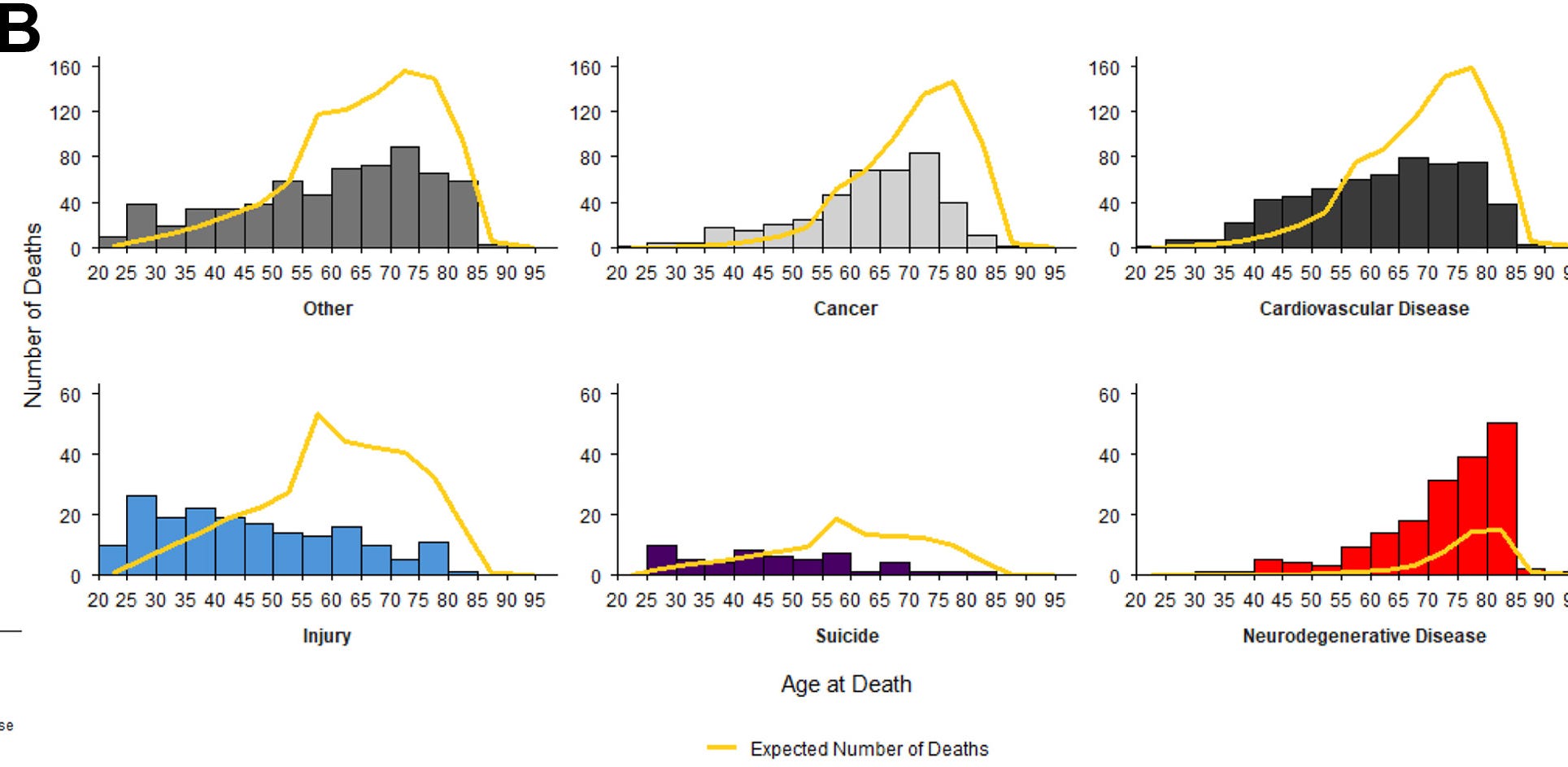
This study is another data point that suggests that playing football is very likely harmful to the brain. If I had to go to my NFL-sponsored gambling app to place a wager on whether football is good, neutral, or bad for the brain, I’d certainly put my money on bad.
However, there is still a long way to go as far as our understanding of the brain and the impact of football. It’s important to keep an open mind as sometimes things we think we know in medicine turn out to be incorrect, due to the imperfect nature of research studies.
For example, one of the suspected root causes of the recent opioid epidemic was a study in 1980 that concluded that giving opioids (narcotics) for pain relief would not cause addiction. This study ended up being completely wrong and is partially blamed for the narcotic addiction crisis - a crisis that has had a significant impact on active and former NFL players.
Here are some of my thoughts on the NFL neurodegenerative disease study: