
Jack Campbell suffered a spinal cord injury on November 1. He offered the first specifics of his spinal injury on November 4. Here is the analysis of his statement, followed by a recap of his injury timeline and the possibility of an incipient injury. As always, wishing the best for Jack in his recovery.
Jack Campbell Statement - November 4, 2026

The key quote is:
“I have full movement in my lower body, and I’m continuing to make progress with movement in my upper body.”
At his press conference on November 4, Dan Campbell added this detail:
“The status is changing every 8 hours, 10 hours in a good way.”
This is very good news that Jack has made significant, consistent progress in the first three days.
Summary of Jack Campbell Spine Injury
Based on the injury videos and public statements:
Jack initially suffered a total paralysis of his arms and legs due to an injury to the cervical area of the spinal cord.
There has been steady recovery of his neurological symptoms in the hours and days since the injury.
Three days later, his lower body (legs) has recovered fully. His arms have recovered partially, as there are still motor deficits.
I consulted with my long-time friend and neurosurgeon Dr. Samuel Hughes regarding this case. Much of the following information is based on our discussion, with certain details locked due to their potentially sensitive nature.
What could be the diagnosis?
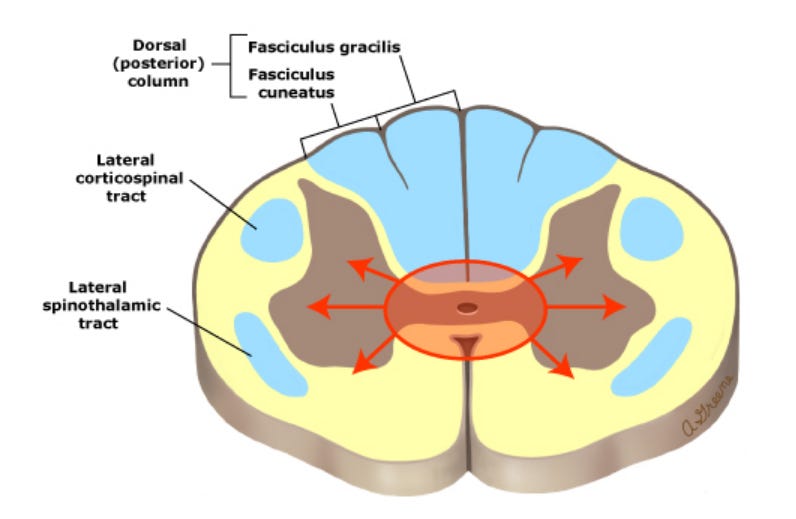
The diagnosis for Jack’s injury almost certainly includes Central Cord Syndrome (CCS), which occurs when the central portion of the spinal cord is damaged. Here is a visualization of the spinal cord with the red circle being the location of damage…
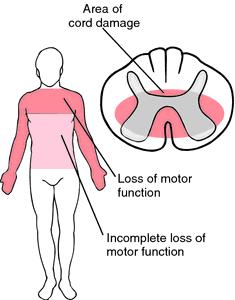
CCS causes motor impairment more so in the arms than the legs. That’s because the nerves that control the arms are more in the center of the spinal cord, while the nerves that control the legs are more on the periphery. This results in a cape-like distribution of symptoms…
What can cause Central Cord Syndrome (CCS)?
Pre-existing cervical stenosis or spondylosis.
Acute injury like spine fracture, disc herniation, spine ligament injury, or spine dislocation.
Lack of blood flow to the spinal cord, such as what can happen in Surfer’s myelopathy. The center of the spinal cord is more susceptible to a lack of blood flow than the peripheral portions of the cord.
Was there a pre-existing spinal issue with Jack?
What is being done for Jack at the hospital right now?
Is surgery a possibility?
The benefits of surgery are controversial with CCS. The MRI/CT findings are key to determining if there is a structural defect that might be correctable.
At this point, surgery may not actually help Jack’s recovery, which is progressing well. If surgery is done in the future, its primary purpose would probably be to prevent future injury.
What are the chances of a full recovery?
The prognosis for CCS is generally good. There is a good chance of a full recovery or close to it. He may not get back to exactly 100% though, as there can be residual numbness or weakness in the hands or arms.
How long might recovery take?
Symptoms can actually worsen before they improve, but with Jack, the symptoms were already likely at their peak immediately with paralysis of upper and lower limbs.
There has already been significant recovery for Jack, as he has regained full motor function of his legs. With a spinal cord injury, early improvement portends later improvement. That’s good news for Jack.
Significant recovery over the next 1-2 months is likely, but the recovery process can still continue for years.
What is Jack’s likelihood of playing football again?
Jack Campbell Expanded Injury Timeline
Some of these videos and information have been posted on my previous stories, but for convenience and clarity, I’m including them here.
November 1, 2026
Seven plays prior to final play:
It’s subtle, but Jack is slightly slow getting up here and appears to have been hurt. He is seen flexing his head down towards the ground immediately after the tackle. No other prior plays stood out when I reviewed the tape.
The six intermediate plays:
The intermediate plays leading up to the final play all look very benign. Jack does not display any obvious disability or weakness.
The last play in this sequence is the most concerning for head trauma as he dives towards the ground on a tackle, but it appears most if not all of the contact is to his shoulder. There is a chance his helmet may have slightly hit the ground but it’s hard to say from this angle. He pops up immediately displaying no compromise.
Final play including on-field management:
Jack is hit in the facemask and immediately goes limp. There is no sign of movement in arms or legs after this.
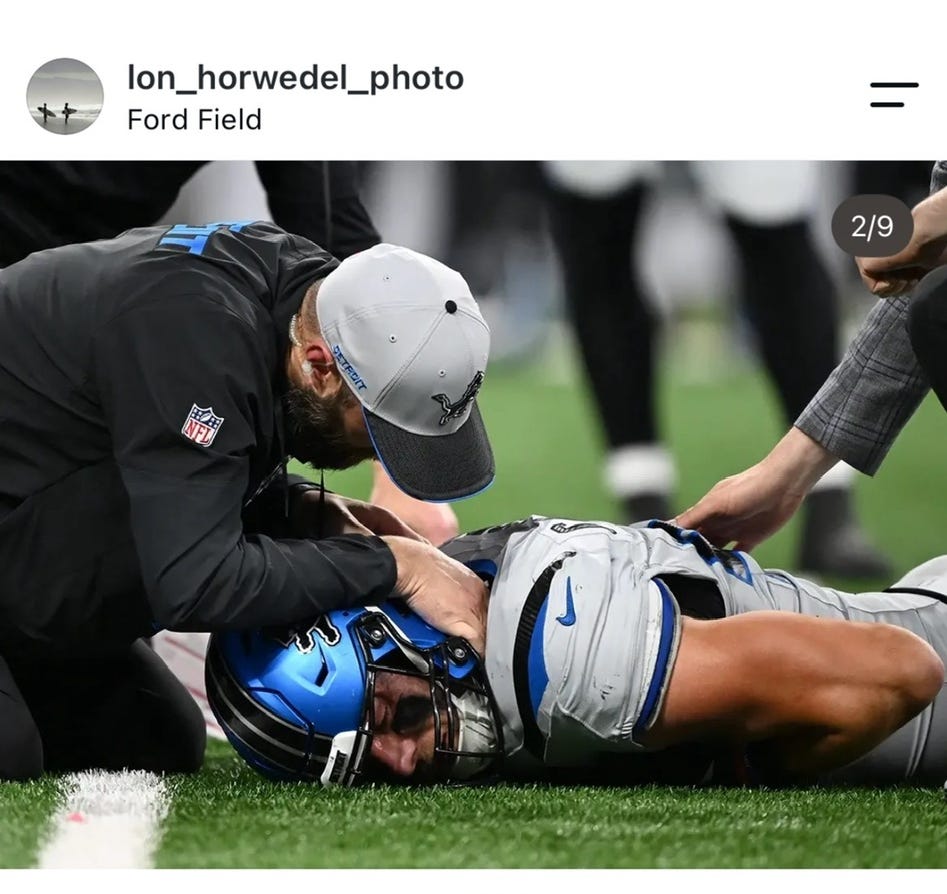
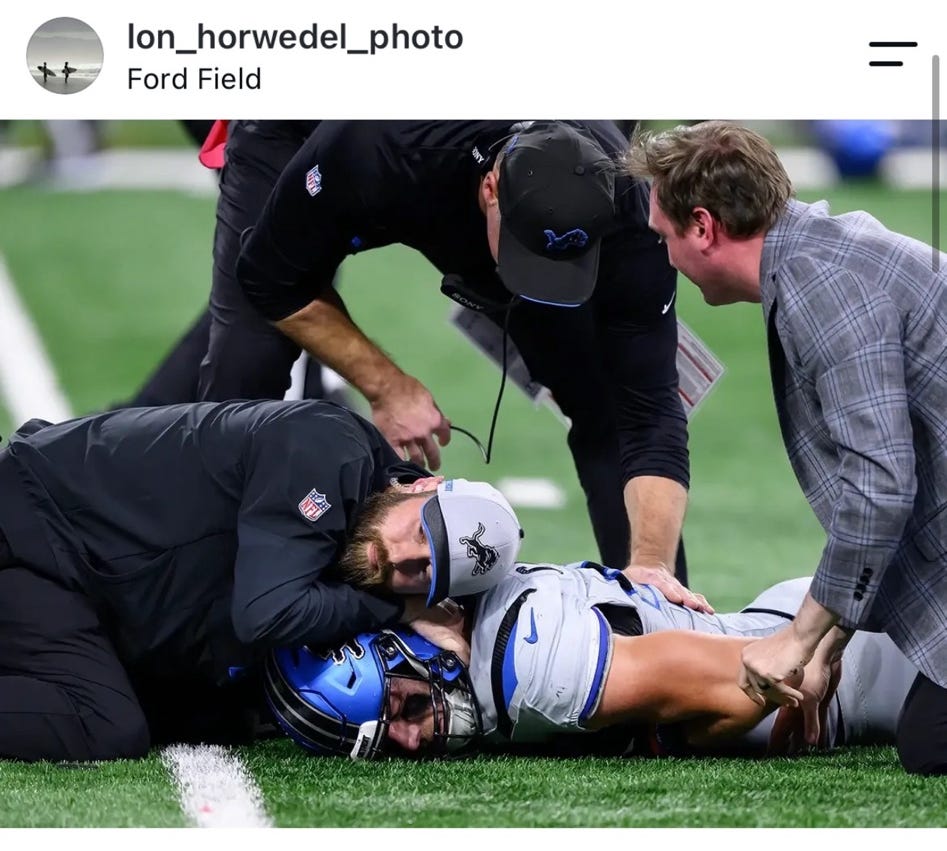
In these pictures, you can see the Lions head trainer palpating the cervical spine to check for issues like anatomic deformity. Medical does an excellent job here immediately evaluating for a spine injury. Both Jack Campbell and Dan Campbell have gone out of their way to praise the medical staff’s management of the injury.
In my previous articles on Jack Campbell, including the immediate postgame injury report, I analyzed the possibility of an antecedent or incipient injury seven plays earlier. For the complete analysis, visit…

Here is a summary of my thoughts…
Theory of Incipient Injury
A theory is an idea that needs to be proven or disproven. Based on logic and probabilities, I’m theorizing that Jack had an incipient injury seven plays prior, that culminated in temporary paralysis.
Here is the logic:
The mechanism of the final play with a heads-up tackle and hit to the facemask is extremely unlikely to cause a spinal cord injury.
The mechanism of the earlier play (7 plays prior) of a head-down tackle and hit to the crown of the helmet is what typically causes a spinal cord injury due to compression of the spine.
Lions fans like me who have watched every play of Jack’s NFL career (usually more than once) know what Jack typically looks like after a tackle. On the suspicious earlier play, he displayed a short, subtle sign of discomfort after making the tackle, suggesting he had been hurt. Many Lions fans picked up on this immediately.
How to prove or disprove the theory?
Jack would have a lot of insight here. On the earlier play, if he indeed felt neck pain or any neurological symptoms to his extremities like tingling, weakness, or pain, then that would support the theory of an incipient injury.
Why might knowledge of an incipient injury be important to Jack?
If Jack has insight into an incipient injury, his experience could help educate future players (and medical staff) as to when a player should get pulled for evaluation… before that final catastrophic event happens.