
A tiny blurb in a recent Tom Pelissero article caught the eye of some Detroit Lions fans, as it referenced cartilage damage in Kerby Joseph’s knee…

Those of you who have followed me over the past year know that the report of cartilage damage is not surprising news. While the source of Pelissero’s medical info is uncertain, it further substantiates the concern I posted on X in November of last year…

Knee Cartilage Types
The knee has two types of cartilage - the meniscus cartilage and the articular cartilage.
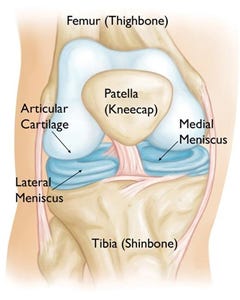
The meniscus cartilage comprises two disc-shaped pieces that act as shock absorbers between the femur and tibia bones. The articular cartilage covers the surface of the bones, allowing the two bones of the knee joint to glide across each other smoothly with minimal friction. While Kerby likely has some meniscus damage, it’s the articular cartilage that is the main problem here.
If the articular cartilage is damaged, increased friction occurs, causing pain, swelling, and disability - all symptoms that Kerby has acknowledged. Articular cartilage damage does not heal and will continue to wear out, thus meriting the terms “degenerative” or “arthritic”.
Kerby Joseph Knee Cartilage Q & A
I received a lot of excellent follow-up questions with this latest report on Joseph. While I am able to give short responses on X, I can provide more detailed, unfiltered responses here (some responses are locked for sensitivity.)
If you have any more questions, message me or leave a comment below.

The Tom Pelissero report changes nothing. Most of the sources for national media are the players’ agents, who have a duty to spin news favorably for their client. Also, the agents are not medical professionals and may not fully understand medically what is going on. Thus, these reports need to be viewed in that context.
We saw a very similar report on Kerby Joseph last December…

Kerby did not end up returning to play last season, and his injury has proven to be career-altering. This is not a knock on Jordan Schultz or other reporters, as they are only reporting what the source (agent) tells them.


Many readers have asked about stem cells and their potential to help with Kerby’s knee. The concept of injecting undifferentiated stem cells into body parts to have them grow into the cells you want them to grow into is tantalizing.

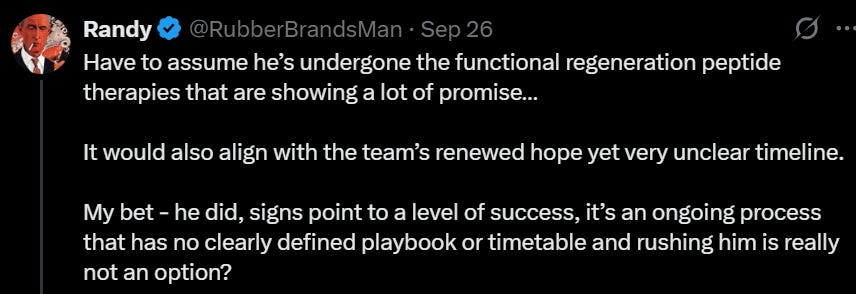
Like stem cells, peptides are another emerging therapy that has captured many people’s interest.

Microfracture has fallen out of favor with the emergence of other types of patching procedures (OATS, MACI, etc.), which are options to repair articular cartilage damage. However, if there is diffuse or widespread damage, those options may be off the table.
Also, patching cartilage does not stop further trauma from occurring to that area. If Kerby’s anatomy predisposes him to articular cartilage damage, the patch will likely also wear out at some point if he continues high-impact activities.
While very unlikely in Kerby’s case, there is always a possibility that a player declines surgery that might help. Nobody can force a player to get surgery, and there are legitimate pros/cons to any surgery. Kerby had hip surgery just the offseason before, so it’s not like he’s averse to getting surgery on a major joint.

A total knee replacement can be an excellent option for low-impact activities like walking, golfing, hiking, biking, and activities of daily life. However, high-impact activities like running and jumping can cause issues with the replacement hardware and subsequent symptoms. Hardware also can’t totally replicate the athleticism of the natural joint, which becomes a critical limiting factor for pro athletes.
Returning to the elite athletic levels required to play in the NFL would be extremely difficult. I don’t know of any athletes who have returned to a professional-level, high-impact sport. Tiger Woods had a knee replacement in the low-impact sport of golf. Lindsey Vonn was able to resume competitive skiing with a partial knee replacement. Both are impressive, but the NFL is a totally different beast.


On multiple occasions last year in camp, games, and practices, we’ve seen Kerby wear a knee brace in efforts to try to take pressure off the knee. Here he is in Week 5 of last year, when he wore a knee brace during the game.
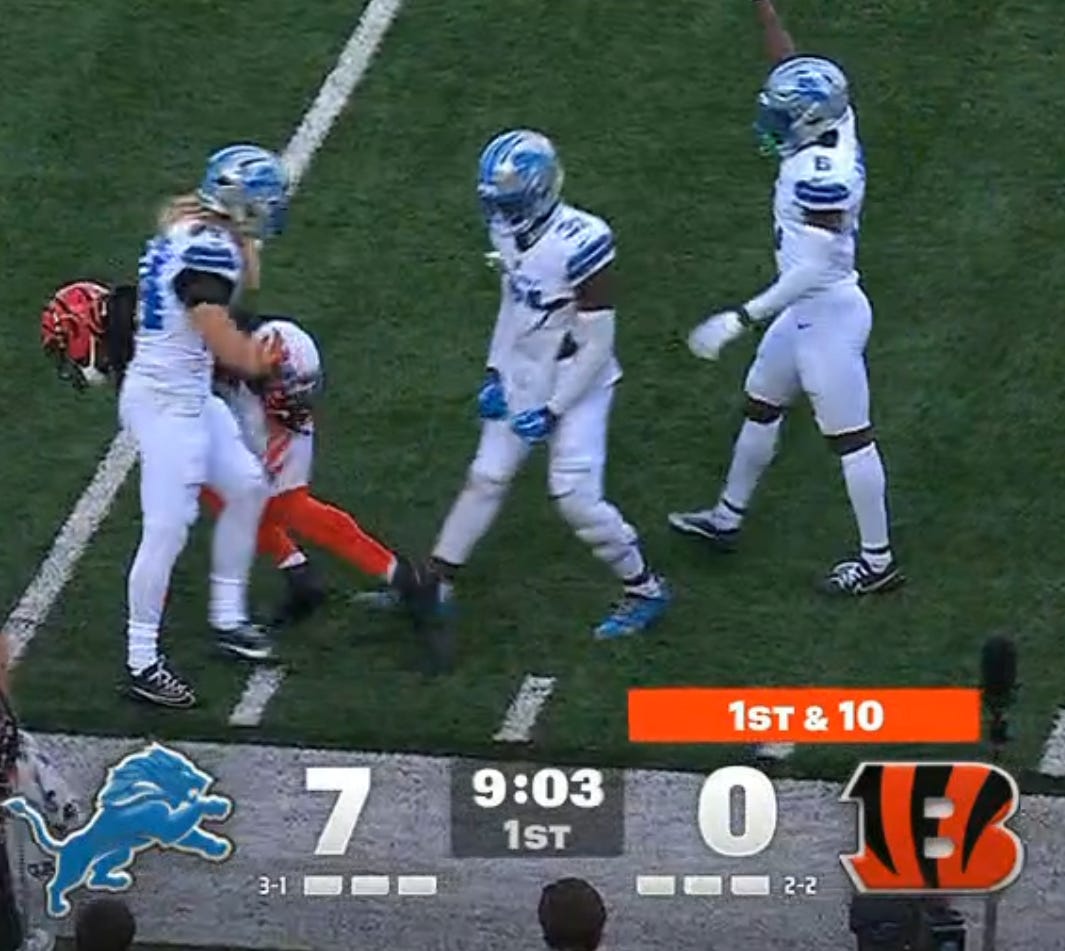
He may be wearing an “unloader” brace which attempts to transfer pressure off the affected area of the knee joint onto other areas of the knee or leg. The immutable laws of physics mean there is only so much that a knee brace can accomplish.
Kerby did not wear the knee brace in Week 6, which tells us that the brace was not an effective solution.

Pain is one of the factors, but this issue goes beyond pain. There is swelling and disability with the joint - both symptoms that Kerby has publicly acknowledged.
In his final game last year, you can see how much difficulty he has just bending his left leg…
His knee likely swells up with high-impact activity, which causes decreased athletic ability. The swelling is also a signal of further damage to the joint. Thus, his symptoms will continue to worsen if he plays football.
Some have suggested that they would be happy to have Kerby Joseph return at something like 70-80% of his previous ability. The problem is that percentage will decrease over time, and potentially very rapidly. We saw this scenario play out last season in his six games.


This is correct that often times there is nothing that can be done. Doctors and therapists can only do so much. Unfortunately, there are many parts of human bodies that simply won’t heal back to normal and are not “fixable”.
I talk about “residuals” frequently when it comes to injuries. Most injuries carry residual effects, some more than others. When it comes to cartilage, the residuals can be huge.

Retirement is absolutely on the table. For financial reasons, Kerby can’t outright retire, which would subject him to a possible signing bonus clawback (see Frank Ragnow, Calvin Johnson, Barry Sanders) or forfeiture of guarantees.
But his agent could negotiate with the Lions to come up with an agreement where Kerby is able to cordially retire as a Lion without having to give up any guaranteed money, and without the ignominy of a release. There is no shame with getting released in the NFL, but Kerby may want to end his career on his own terms.

Optimism is excellent for mental health - both for fans and players. We’ve seen Kerby express optimism at many points throughout this process, which is great. However, when it comes to medical conditions, optimism needs to be balanced with realism, so that the best decision can be made for one’s short-term and long-term health.

For more on Kerby Joseph including his knee injury timeline…
Kerby Joseph knee injury analysis - Part 1

With Kerby Joseph heading to IR, a tumultuous season-long saga is over. Here is the complete analysis based on what we know as of December 20, 2025.