
I received a lot of excellent questions and comments on Aidan Hutchinson’s ACL injury, including key issues of associated damage and projected return timeline. I’ve compiled as many of the questions as I could below.
To recap, here is the video showing the tibia (lower leg bone) that pops forward when the ACL ruptures and then pops back into place. The freeze-frame shows the deformity of the knee due to the ruptured ACL…
For more of the initial analysis of Aidan Hutchinson’s ACL injury visit these stories…


Now let’s get to all your questions and comments starting with the major questions…
(Some of the details are locked due to potentially sensitive nature.)
What about associated meniscus damage?
With the torn ACL confirmed, the next key question is whether Aidan suffered any meniscus damage, which is found in about 50% of ACL tears. There was conflicting information, with early reports stating there was likely to be meniscus damage…

and later reports stating there was no “significant” damage…

In Dan Campbell’s press conference on November 17, he strongly implied that there was some meniscus damage for Hutchinson. See my previous article for the full quote…

What does this tell us about the earlier conflicting national reports? As always, it’s important to understand where these national reporters are getting their information. Most often, the source is the player’s agent who has a vested interest in spinning news favorably for the client. Thus, we need to read their reports with that in mind.
Why is meniscus damage so key?
The meniscus acts as the shock absorber for the two bones of the knee - tibia and femur.
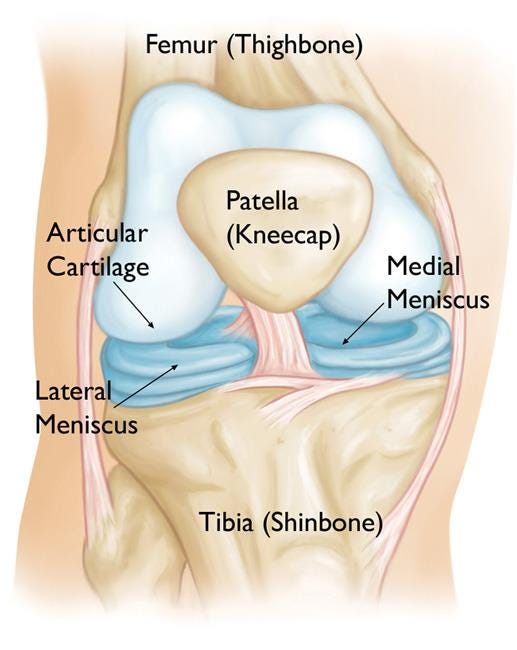
Many players have some level of meniscus damage, and many play entire careers with it. However, damage to the meniscus puts the knee at increased risk of damage to the important articular cartilage, which is the slick cartilage covering the surface of the bone that protects against “degenerative” or “arthritic” knee.
Why may there be uncertainty about Hutchinson’s level of meniscus damage?
What about other knee ligament damage?
When the ACL is torn, it’s possible there is also knee ligament damage of the MCL, PCL, or LCL. For example, last year Patrick Mahomes had an ACL/LCL combo.
With Hutchinson, there have been no reports indicating any other ligament damage at this point. Given how clean and straightforward the video looked and the fact that there was no contact trauma, I’m optimistic that it was only the ACL that was injured.
If there is any additional ligament damage, that could extend his recovery timeline.
What is the best-case timeline for Hutchinson?
If this is an isolated ACL tear without significant meniscus damage, that makes an optimistic timeline much more likely and a return for the start of the 2027 season realistic.
Here are some recent cases. (Included is sack production in first year back):
Defensive linemen:
Rashan Gary 11/6/22 ⟶ 9/10/23 = 10 months (9 sacks)
Alim McNeill 12/15/24 ⟶ 10/20/25 = 10 months (1 sack)
Grady Jarrett 10/29/23 ⟶ 9/8/24 = 10 months + 1 week (2.5 sacks)
Von Miller 11/24/22 ⟶ 10/8/23 = 10 months +2 weeks (0 sacks)
Lions:
Jameson Williams 1/10/22 ⟶ 12/4/22 = 10 months + 3 weeks
Malcolm Rodriguez 11/28/25⟶ 11/23/25 = 12 months (follow-up surgery was required)
Outliers:
Adrian Peterson 12/24/11 ⟶ 9/9/12 = 8 months + 2 weeks
Associated damage causing prolonged recovery:
Jack Conklin (ACL/MCL/PCL/meniscus) 9/10/23 ⟶10/13/24 = 13 months
Nick Chubb (ACL/MCL/meniscus/medial capsule) 9/18/23 ⟶ 10/20/24 = 13 months
Micah Parsons (repaired medial & lateral meniscus tears) 12/14/25 ⟶ pending
How might the meniscus damage delay Hutchinson’s timeline?
If Hutchinson avoided any significant associated damage (a minor trim of meniscus would not be a big deal), then he could realistically return in 10 months for the start of next season - first Sunday is on September 12, 2027.
If Hutch has a meniscus tear that is amenable to repair, that can lead to a longer timeline like we are seeing currently with Micah Parsons…

Parsons underwent a repair of his meniscus, which in his case necessitated non-weight-bearing for about two months to allow the sutured meniscus to heal. This caused significant muscle atrophy and set back his rehab timeline. (Note: Not all meniscus repairs require non-weight-bearing.)
Parsons describes his surgery and rehab in this video.
If Hutchinson has significant meniscus damage that is NOT amenable to repair, then the shorter timeline might apply since he does not need to wait for the meniscus to heal. However, there would be increased concern for his long-term knee health. Generally, the orthopedic surgeon does not know if the meniscus is repairable until the knee is opened up.


The ACL reconstructive surgery works amazingly well. The limiting time factor for the ACL recovery is the healing of the reconstructed ACL graft to the bone. There is no way to speed up this natural healing process, which can take about 6-9 months to be mostly healed, but can continue for up to two years.

Spending all that time rehabbing can’t be fun. The good news with ACL rehab is it is tried-and-true with a reliable timeline and recovery. Many players have successfully gone through it, including Alim just recently, so there is a well-defined path to follow.

While Hutch will likely play most, if not all, of the 2027 season, there is the unknown of his productivity during his first season back. We saw Alim struggle during his first season back, and is only now back-to-prior-form during his second season.
There are many possible reasons for this. One of them is that the healing of the reconstructed ACL to the bone can continue for up to two years - as evidenced on MRI studies. So while it is very safe to play after about the 9-month mark, there is still healing going on for a while afterwards.
Overcoming mental hurdles is another major factor.

(Note that Hutch’s tib/fib fracture was on the opposite leg of his current ACL.)
Starting on the PUP list is likely for Aidan for a couple reasons.
There is no drawback to starting on PUP, because you can come off the list at any time.
If you don’t start training camp on PUP, you can’t go on it later. The only option for a list at that point is IR.


Here are Aidan Hutchinson’s snap count percentages in 2026 prior to his ACL injury:
83%
85%
97%
93%
90%
87%
94%
89%
2026 Average: 90%
In the two prior seasons, Hutchinson averaged 91%. Thus, there was no significant change in his deployment for 2026. The typical snap count average for top edge rushers is in the 70-80% range. See my earlier story for the full analysis…

It’s a plausible theory that wear-and-tear over the course of the season(s) could have contributed to the ACL injury. Once he returns from this injury, maybe we finally see his snap counts reduced to a level consistent with his peers.

I understand the concern of three significant leg injuries, which includes an ankle fracture in college. Optimism is warranted though as his 2024 tib/fib fracture with no joint involvement can have minimal-to-no residuals. An isolated ACL can also have a pretty much 100% recovery with no residuals. The hope is that there is no significant cartilage damage.
And yes, the Lions have had terrible injury luck with the recently-extended Jack Campbell, Kerby Joseph, and now Aidan Hutchinson.

The hope is that by mid-late of the 2027 season, Hutch will be close to his normal self. But it’s certainly possible, he won’t get there until 2028. Additionally, his age starts becoming a factor, as he enters the 2028 season at age 28.
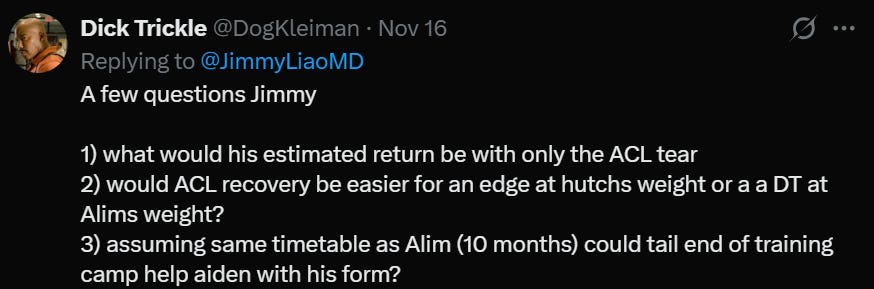
Regarding the question of whether training camp might help Aidan’s recovery, that’s a good thought. It might help, but I don’t see it as a big factor. He can do all the strengthening, conditioning, and workouts recoveries on his own.


The major difference with a natural jump in a game or workouts is that the leg is properly bracing for the landing, meaning the knee is ready to bend to absorb the force.
With Hutchinson’s strike-a-pose landing, he is purposely locking the knee in a fixed position, thus creating a significantly higher and different stress on the knee. All those landing forces need to be dispersed somewhere, and in Aidan’s case, it was unfortunately in the ACL.
No one has a problem with Hutch jumping during a game or during controlled workouts to get ready for games. It’s the unnecessary jumps of an unnatural celebration, or something like playing basketball or volleyball in the offseason, that people are requesting to be avoided.

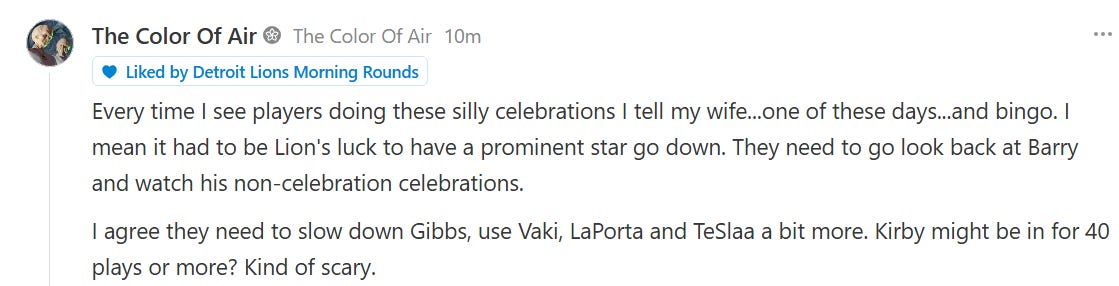
One good thing that could come out of this is if it prevents any future celebration injuries to Lions (and any other athlete). Jameson’s flips into the end zone and St. Brown’s Superman jump over Gibbs come to mind.
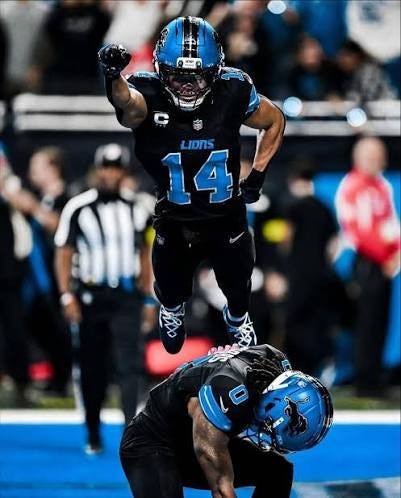
Looks awesome and makes for a great poster, but is it worth the risk? Kerby Joseph’s acrobatic back flips probably should have ended a long time ago also. Adopting the Barry non-celebration might be the way to go.

Well, I guess Dan Campbell says he hurt his bicep by fist pumping, so maybe that’s not even totally safe. But in all seriousness, there are varying levels of risk with celebrations, and a fist pump is much safer than jumping and landing to strike a pose.

There is no way to know the answer to this for sure. My opinion, which I stated in my Risky Celebrations Analysis Story, is that the celebration put an unnatural stress on his knee. Thus, there is at least a decent chance that Hutch never tears his ACL if he does not do the celebration.
There has been a ton of debate publicly and privately about whether Hutchinson’s celebration injury was avoidable, or if the ACL was already compromised and the rupture was inevitable. So I appealed to the “wisdom of crowds” with this Twitter/X poll. Here are the results so far…

Feel free to check the latest results and cast your vote by clicking the screenshot, or leave any follow-up questions or comments below. Wishing the best for Aidan in his recovery.