
Kerby Joseph returned to the field on November 22, 2026, more than 13 months after his last game. The absence was due to a left knee injury that never had a specific reported diagnosis… until now.
My immediate suspicion back in November 2025 pointed towards articular cartilage damage…

A report by Ian Rapoport on November 22, 2026 confirmed that articular cartilage damage is indeed the diagnosis. Click on the screenshot for the post with video…

Here is the quote from Rapoport:
“Dealing with articular cartilage issue. Has been to a regeneration doctor. Has built up strength back in his knee.”
While the source of the information is unknown (usually it’s the player’s agent) - and national reports can sometimes mislead (see Jalen Hurts) - it is very unlikely that a specific medical term like “articular cartilage” would be misconveyed.
Before I delve into the ramifications of Kerby’s diagnosis, here is a review of his first game back after 13 months. (Some content is exclusive to paid subscribers due to its potentially sensitive nature.)
How did Kerby look in his first game back?
The first thing to note is he did not have any obvious, significant setback during the game like we saw multiple times last season. That’s a big positive.
Kerby played a lot of snaps (46 total, 67%) but wasn’t involved much in direct action with the ball - maybe this was purposeful, maybe this was pure chance. Thus, his knee wasn’t put in much risk during the game. He was credited with two tackles total.
Early in the game, he was reserved for passing situations like 2nd or 3rd and longs. About midway through the 2nd quarter, he started showing up on some 1st-and-10s. There were no big gaps in the game where he was absent.
I have reviewed the tape of Kerby’s game multiple times. Here are videos of four key plays, which include his two tackles and his longest sprint of the day.
Play #1: By far the biggest hit Kerby delivered during the game
Kerby makes a tough tackle and survives the hit pretty well. Most of the force was on the right side of his body, thus his left knee did not have to bear much force…
Play #2: This “tackle” on Baker was just a barely glancing blow
Not much to see on this play…
Play #3: Bucky Irving 80-yard TD run that was called back
Kerby overestimates his own speed and takes a terrible angle, letting Irving out the gate for an extra 65 yards or so…
It’s almost certain that Kerby will have some loss of athleticism due to the knee cartilage damage, and he will need to recalibrate for that. It’s quite possible that “rust” and deconditioning of his legs were a factor in his first game back as well.
Play #4: Kerby appearing to favor his left knee
Can Kerby still be an effective player?
Yes, as I’ve always felt that Kerby’s greatest strength is his ability to read the field, anticipate throws, and fool the QB… resulting in a ridiculously high interception rate. If he can occasionally get a pass breakup or pick up an interception, that may be good enough. Laying big hits, stopping the run, and covering a lot of ground may not be up to his usual standards moving forward though.
Now, let’s get to the ramifications of Kerby’s articular cartilage damage diagnosis, which includes many good questions from readers and followers…
Kerby’s “regeneration” doctor


Kerby warmed up before the game with a leg sleeve, which can be for swelling, warmth, a little bit of padding, or psychological comfort. The sleeve is not doing anything to protect the cartilage. It’s possible the sleeve could help with pain, which is a subjective sensation.
Kerby did not appear to play the game with a sleeve, which supports the fact that the sleeve is doing nothing for the cartilage.
Why not a more substantial knee brace? He tried that in just one game last year - Game 5. It must not have been comfortable or effective, as he did not use it in Game 6 - his final game of last season.
For a ligament issue, a knee brace can be effective. For a cartilage issue, a knee brace may have limited to no value. An “unloader” knee brace can try to take some of the weight off the joint, but it can only do so much.

Here are some things to watch for during his games (beyond any obvious limping or pain):
Look to see if he subtly favors that left leg to try to minimize pressure and weight on it. He needs to limit the forces on his knee joint to preserve the articular cartilage and allow it to last as long as possible.
Watch for any big stretches of the game where he is absent. This could represent a flare-up of the knee.

This question is where many are torn regarding how to root for Kerby. If you care about Kerby’s long-term knee health, you probably should be rooting for him to not play football.
Kerby is a grown man and as long as he has all the information, he has a right to make the choice that’s right for him.
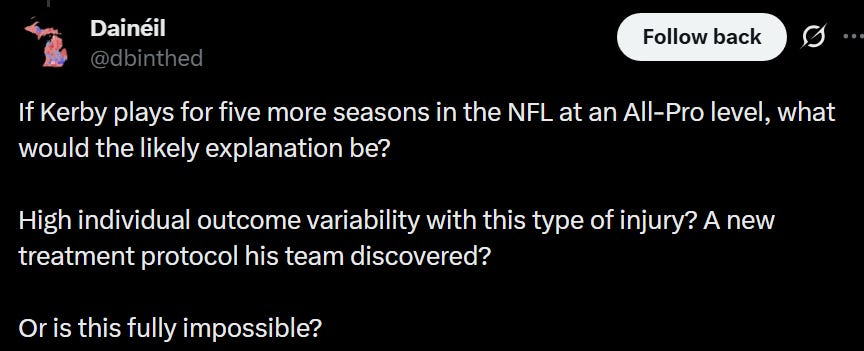
If Kerby can play at a reasonably high level for a long time, then that means he and the Lions (or whatever team he’s playing for) are doing a good job load-managing his knee. That probably includes limiting his practice workload and limiting snap counts on gameday. Reserving his snaps for obvious passing situations is a good way to maximize his special skills while reducing load on his knee.
A long career probably also means that Kerby has modified his play style to stay away from situations and actions that put his knee at risk. That might mean avoiding contact as much as possible, and avoiding hard cuts on that left knee.

I addressed this question in my Week 4 Final Injury Report Article, and am reprinting it here, with some addendums, for those who missed it.
Knee cartilage damage is very much a case-by-case basis issue. Imaging like MRIs are not perfect for picking up cartilage damage. We are seeing this fact right now with Aidan Hutchinson, who has an uncertain level of associated meniscus damage with his ACL.
Also, what shows up on imaging does not necessarily correlate with the subjective symptoms. Thus, it is very difficult for the doctor or patient to predict what the future holds when it comes to cartilage damage. What can add even more difficulty to the doctor’s evaluation is if the patient does not accurately and honestly report symptoms (see #4 below).
There are multiple possibilities as to whether there was knowledge of a cartilage issue prior to Kerby’s extension. Here are the hypotheticals in no particular order:
#1. Neither Kerby nor the Lions had any indication of an emerging knee cartilage issue. There may have been no symptoms or imaging concerns prior to the extension. The cartilage wear-and-tear may have hit a tipping point where it started to cause symptoms after the extension. Or an acute event damaged the cartilage after the extension. Neither of these possibilities is unusual.
#2. Kerby and the Lions both knew about early cartilage issues, but did not expect it to worsen so rapidly. It’s possible there were signs of some cartilage damage and even arthritis on MRI and X-ray, but it’s very difficult to predict when or if the damage will become a career-altering issue. We have seen this play out recently in the trades of AJ Brown, whose “degenerative” knee has become a major problem in his first year with the Patriots, and Quenton Nelson, who had knee cartilage surgery after just one game with the Seahawks.
Players can play entire careers with articular cartilage damage. A notable example is former #1 overall pick, Jadeveon Clowney, who underwent microfracture surgery in his rookie season and is currently playing his 13th season in the NFL and has 5.5 sacks on the year.
#3. Kerby was aware of mild symptoms, but the Lions were not. Players have aches and pains all the time in the NFL, so some knee soreness during the 2024 season may not have raised any unusual concern from Kerby’s viewpoint. He may not have even had it fully evaluated on the assumption that it would improve with rest over the offseason, like most other aches and pains. Any symptoms likely did improve with the three months of rest prior to signing his extension.
#4. Kerby was aware that a serious issue was brewing, but the Lions were not. This is the most controversial of the possibilities. Players can hide their symptoms from the medical staff. This happens all the time when players dodge concussion diagnoses.
Players also have the ability and right to seek counsel from an independent (non-team-affiliated) doctor for advice - in fact, I fully encourage players to do so for pretty much everything. Is the player required to report all their findings back to the team? I’m not sure of the exact language of the NFL contract, but even if a player is required to report back to the team, there is bound to be some gray area here. For example, if a player contacted me for advice, there would be no way for the team to know about it. Even if the team somehow found out, I would not be required to tell them anything. My allegiance would be entirely to the player.
Hiding symptoms from team medical prior to negotiating an extension clearly would help the player in negotiations. Is this ethical? That’s a separate discussion, but there’s no doubt it happens all the time, and I don’t blame players for doing what’s right by them. If the player is not forthcoming about symptoms, it’s hard to blame the medical staff for missing something.
Any other questions? Let me know…
Paid subscribers are welcome to start or join a chat where there are no judgments and sensitive topics are allowed…

For a retrospective of Kerby’s knee saga that started in July of 2025, visit these stories…


