
There was uncertainty whether Kerby Joseph’s knee would even be able to start practicing given that he hadn’t practiced all calendar year. Thus, it was a big step in his comeback attempt to see his 21-day practice window open up yesterday.
Dan Campbell had quite a bit to say about Kerby’s return. Here is my read-between-the-lines analysis of his quotes followed by some good reader questions.
Strengthening the Knee
“The strength in the knee is good - the thigh, the quad, all of that.”
Campbell has mentioned many times over the past few months that part of the goal has been to increase strength in the knee muscles. That’s because there is nothing that can be done to strengthen cartilage, so you do what you can. For why I suspect this is a cartilage issue, visit my Kerby Joseph Analysis Part 2 from January.
Strengthening the muscles can maybe take some of the load off the knee joint, but how much is debatable. If joint health was about muscle strength, then all these incredibly strong NFL players would have healthy joints - they do not. Regardless of muscle strength, there will still be impact on the knee joint.
Knee Shock Absorbers
“It was always about getting that leg strength equal to that other leg. That’s part of your shock absorbers. That reduces some of the stress on the knee.”
When Campbell mentions “shock absorbers”, that’s a primary role of knee cartilage. The meniscus cartilage is in between the two bones of the knee joint and helps absorb shock.
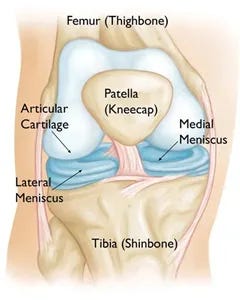
The reason to absorb shock is to protect the essential articular cartilage, which covers the surface of the bones and allows for a frictionless, well-functioning knee. With Kerby, it’s the articular cartilage that is likely worn out, but he probably has meniscus cartilage damage as well - specifically medial-side damage as deduced in this earlier story.
Ramping Up to Football Activities
“You’re doing a little more pounding. How does the knee react? Is there swelling, is there not? Is he ready the next day?
We try to mimic as much football, but we can’t do football.”
Campbell is describing the gradual ramp-up, along with the monitoring of symptoms that would indicate further damage to the knee - like swelling. The more pounding the knee takes, the more likely there will be damage to a joint that is lacking protective cartilage.
Kerby presumably has been able to handle the workouts well enough so far, but he hasn’t tested it with football activities yet.
What is the Immediate Future for Kerby?
“Now that he’s passed all those tests, it’s about getting him out there. Balls in the air, it’s a handoff, him breaking from the post and doing it over and over and over in real explosive reps with real bodies around. We’re not even there yet. We’ll be progressing into that late week, early next week.
The rest is how does he react to football play like movement skills of true football with real bodies and the intensity of it.”
To this point, Kerby has been doing workouts in a consistent, controlled setting. See my story from last week for a recent workout video. As Dan correctly points out, the irregular and uncertain dynamics of a sport will add a different level of stress to the knee.
Repetitive explosive reps requiring sudden change of direction will really test the knee joint. Nobody knows right now how the knee will respond.
Questions and Comments From Readers

The muscles and tendons are not the source of his injury, but rather the cartilage. The hope is that strengthening his muscles helps prevent further trauma to the cartilage.

Dreadfulsean’s skepticism is on point. Can Kerby handle a full NFL practice, much less multiple practices in a week? He tried twice last December and was not able to practice more than once a week. He hasn’t had a full practice yet this calendar year.
I don’t think he needs to practice full weeks though. The most likely way to actually get him on the field and keep him there is to restrict his workload to the bare minimum during the practice week and put him on a limited snap count on game day.

What Tim is describing is an “allograft” which uses donor tissue. Usually, the tissue is from a deceased donor, but if Tim is willing to give up cartilage while alive, that’s cool too (seriously don’t). One big problem with an allograft is the potential for immune rejection. That’s why an “autograft” - using the patient’s own tissue - is generally much preferred.
The OATS (Osteochondral Autograft Transfer System) procedure moves one’s own cartilage from a healthy site to the damaged site.
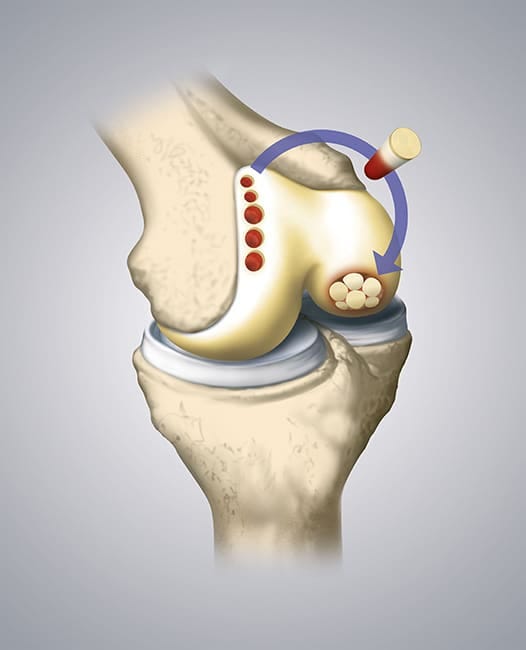

OATS, MACI (Matrix-Induced Autologous Chondrocyte Implantation), and other “patching” procedures are options for articular cartilage loss.
The recovery typically involves non-weight-bearing for multiple weeks followed by multiple months of rehab. We probably would have heard about it if Kerby had such a significant procedure done.
Last year, Kerby described the condition as unfixable, and Dan Campbell said it was something that just needed to be managed. Thus, Kerby probably is not a candidate for these procedures. For him to decline such a procedure is possible, but seems very unlikely.
The other key thing to know is that having a patching procedure done does not mean you should automatically go back to doing whatever you want with the knee - like playing high-impact sports. Whatever factors resulted in the cartilage wearing out in the first place (anatomy, meniscus damage, etc.) can result in the patch wearing out as well.

Stephen makes a great point that it’s not just about Kerby’s ability to play, it’s also about how well he can play. The knee is compromised. How much athleticism will this take away, and how much will it affect his abilities?
I’ve always felt that Kerby’s greatest strength is the ability to read the field, fool the QB, and anticipate the right position to grab interceptions. So he may still be very productive despite decreased athleticism.

Brier makes a good observation about the lack of a knee brace. Kerby wore a knee brace in one game last season - Week 5. He did not wear it the following week in Week 6, which tells us that the brace was too cumbersome to play with or that it was ineffective. He wore a brace during practices last December when he tried to come back.
The knee brace may be an “unloader” brace, which can take some of the pressure off the knee joint. But a brace can only do so much. There is logic to the philosophy of if you’re going to test the knee, then give it a full test without a brace - especially if you’re not planning on playing with a brace. Thus, I don’t think the lack of a brace in practice necessarily means anything.

I agree there may be quad muscle atrophy in the video. Dan Campbell also has confirmed muscle atrophy and weakness. The reason for atrophy is likely because Kerby has been limiting impact on the knee to allow it to heal as much as possible while preventing further damage.

I share spartandawg’s concern. Once articular cartilage is worn away, there is increased friction and grinding of the joint. Over time, the symptoms will only get worse if the joint continues to take on high-impact stress like playing football.
Even if Kerby can handle the ramp-up to full football activities, it would still be smart to put a hard limit on him in practices and games. Because if the knee flares up again, it could mean shutting him down for the rest of the season. Last year, the knee popped up on the injury report after just Week 1, and he was done for the season after Week 6.

The bottom line here is that some excitement for Kerby’s return is warranted, but there is still a ways to go before we will know if he can handle game action, string multiple games together, and perform at a high level.
For a retrospective of the past year with Kerby Joseph, visit these stories. (Some of the content is locked for sensitivity.)


